
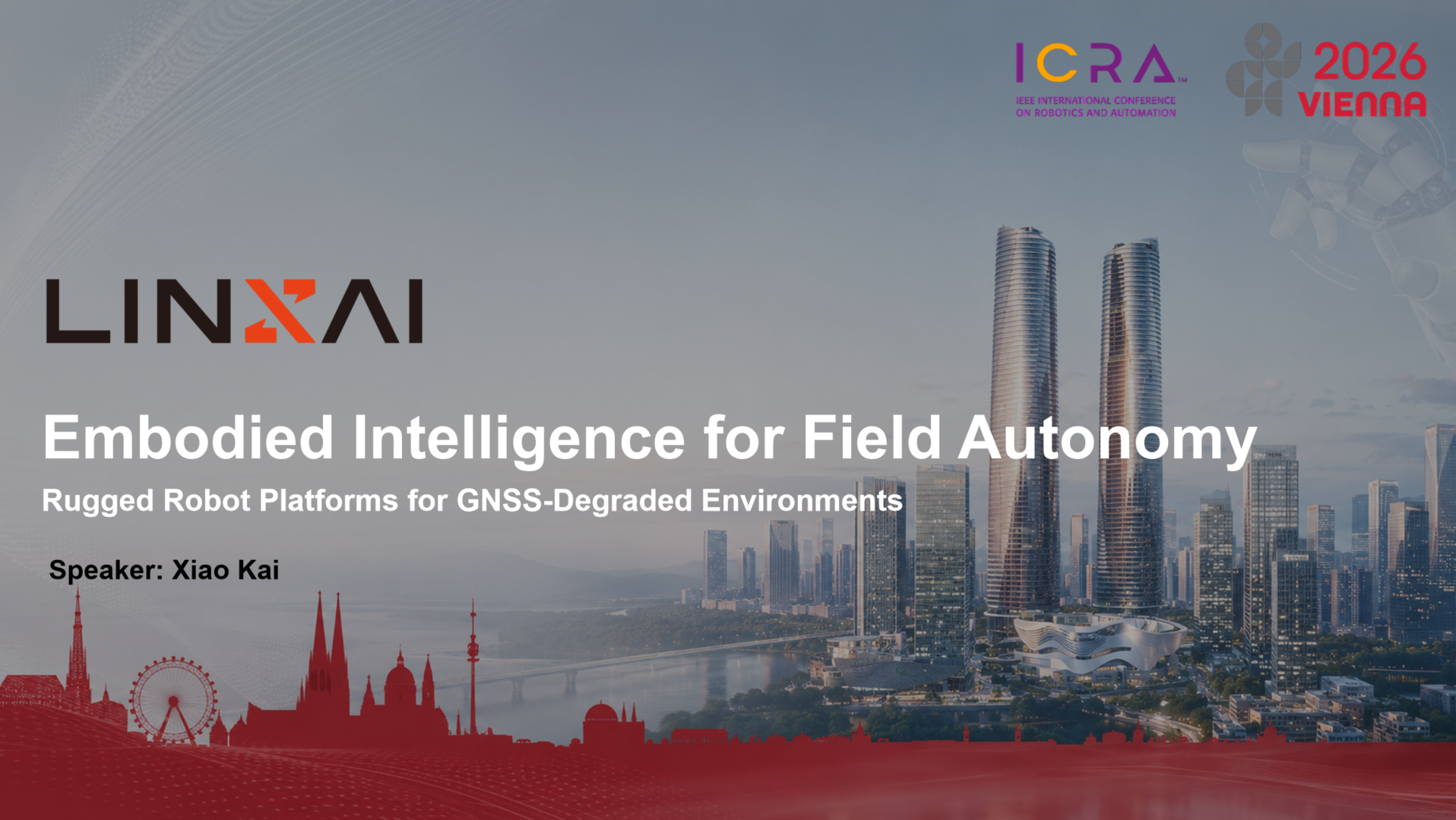
In June 2026, one of the most influential international conferences in robotics and automation—the IEEE International Conference on Robotics and Automation (ICRA 2026)—was held in Vienna, Austria.
As a leading academic event in the robotics field, ICRA brings together top universities, research institutions, and robotics companies from around the world to explore the future of artificial intelligence, robot control, and embodied intelligence.
At this year’s conference, Xiao Kai, Founder of Chinese embodied intelligence robotics company LINXAI Robotics (灵锶智能), was invited to deliver a keynote speech titled “Embodied Intelligence and Field Autonomy: From Lab to Real-World Deployment.” He presented LINXAI’s technological progress in autonomous mobility in complex environments, robot localization, and industrial-grade quadruped robot applications to global robotics experts.
From Academic Research to Real-World Applications: The Next Stage of Embodied Intelligence Robots
In recent years, embodied intelligence has become a major direction for the global robotics industry.
Unlike traditional robots that perform automated tasks in fixed environments, embodied intelligence robots must possess perception, decision-making, motion control, and environmental adaptability to complete complex tasks in the real world.
However, moving robots from laboratory environments to industrial sites still faces many challenges:
- Autonomous locomotion in unstructured environments
- Precise localization in GNSS-denied environments
- Stability during long-duration operation
- Dynamic balancing under heavy payloads
In his ICRA 2026 speech, Xiao Kai focused on LINXAI’s technical roadmap for “field autonomy” and introduced the company’s Ranging and Perception Fusion Architecture.
This technical solution is designed to solve localization challenges for quadruped robots in underground spaces, industrial facilities, and complex outdoor environments.
Solving GNSS-Denied Localization for Autonomous Robot Navigation
For industrial quadruped robots, localization capability is key to autonomous operation.
In environments such as tunnels, underground utility corridors, and indoor factory areas, traditional GNSS satellite positioning signals may fail completely. Relying only on a robot’s own odometry can easily lead to cumulative errors.
To address this challenge, LINXAI has built a multi-source fusion localization system that integrates:
- GNSS/RTK
- UWB ultra-wideband positioning
- SLAM simultaneous localization and mapping
- LiDAR
- Leg odometry
By fusing data from multiple perception sources, the system achieves stable localization in complex environments.
This technical approach enables quadruped robots to break through the environmental limitations of traditional mobile robots and maintain autonomous mobility and task execution capabilities even in GPS-unavailable areas.
Three Core Technologies Supporting Industrial-Grade Quadruped Robot Applications
To meet the demands of real industrial environments, LINXAI has built three core technology capabilities around embodied intelligence robots.
1. AI Motion Control and Reinforcement Learning Algorithms
Complex terrain places higher demands on quadruped robot motion control.
LINXAI’s independently developed SVIP visual reinforcement learning algorithm, combined with a Real2Sim simulation training framework, allows robots to continuously optimize motion strategies based on real-world data.
Compared with traditional methods that rely on manual parameter tuning, reinforcement learning helps robots improve:
- Terrain adaptability
- Obstacle-crossing capability
- Dynamic balancing ability
- Long-duration operational stability
This enables the robots to adapt to complex environments such as industrial stairs, gravel roads, and outdoor slopes.
2. High-Torque Precision Joint Technology
Heavy-load capability is a key difference between industrial quadruped robots and ordinary consumer-grade robots.
LINXAI has independently developed high-torque precision joint modules by optimizing:
- Torque density
- Heat dissipation structure
- Mechanical strength
These improvements enhance the robot’s motion stability under high-load conditions.
This technology provides core support for the D50 series heavy-payload quadruped robot, enabling 50 kg continuous payload capacity and higher peak payload capability.
3. Multi-Sensor Fusion Autonomous Navigation
Industrial environments are highly uncertain.
By fusing vision, LiDAR, positioning systems, and motion state information, LINXAI enables robots to understand environmental changes and autonomously complete inspection, transportation, and detection tasks.
D50 Heavy-Payload Quadruped Robot: Designed for Complex Industrial Environments
As LINXAI’s flagship product, the D50 series heavy-payload quadruped robot is built for industrial application needs.
Key features include:
- Industrial-grade structural design
- Strong payload capacity
- IP67 protection rating
- Wide-temperature environmental adaptability
- Complex terrain crossing capability
The D50 can enter areas that traditional wheeled robots struggle to reach, including:
- Power pipeline corridors
- Industrial factory areas
- Tunnel spaces
- Disaster sites
By carrying different sensor payloads, the robot can perform:
- Automatic inspection
- Environmental monitoring
- Emergency reconnaissance
- Equipment inspection
From Demonstration to Deployment: LINXAI Quadruped Robots Are Entering Real-World Scenarios
LINXAI has always been committed to advancing robotics technology from the laboratory to practical applications.
At present, the company’s robot platform has been applied in multiple industry scenarios.
Power and Tunnel Inspection
In underground environments with limited GNSS signals, LINXAI quadruped robots can carry multimodal sensors to complete inspection tasks, reducing the need for personnel to enter dangerous areas.
Emergency Rescue
In extreme environments such as firefighting, robots can enter high-temperature and heavy-smoke areas, providing on-site data support for rescue teams and improving rescue efficiency and safety.
Industrial Safety Inspection
In high-risk industries such as petrochemicals, robots can carry inspection equipment to perform patrols and data collection in hazardous areas.
Toward the Next Generation of Embodied Intelligence Robot Platforms
From the ICRA 2026 venue in Vienna to complex industrial sites, LINXAI is exploring a development path from technical research to large-scale application.
In the future, LINXAI will continue to advance product innovation around:
- Industrial-grade quadruped robots
- Autonomous navigation technology
- Embodied intelligence algorithms
- Multi-scenario robot applications
Enabling robots to enter environments that people are unwilling, unsuitable, or unable to enter safely is a direction LINXAI will continue to explore.
By integrating artificial intelligence, robot control, and industrial application experience, LINXAI aims to become a trusted embodied intelligence robotics partner for customers worldwide.