
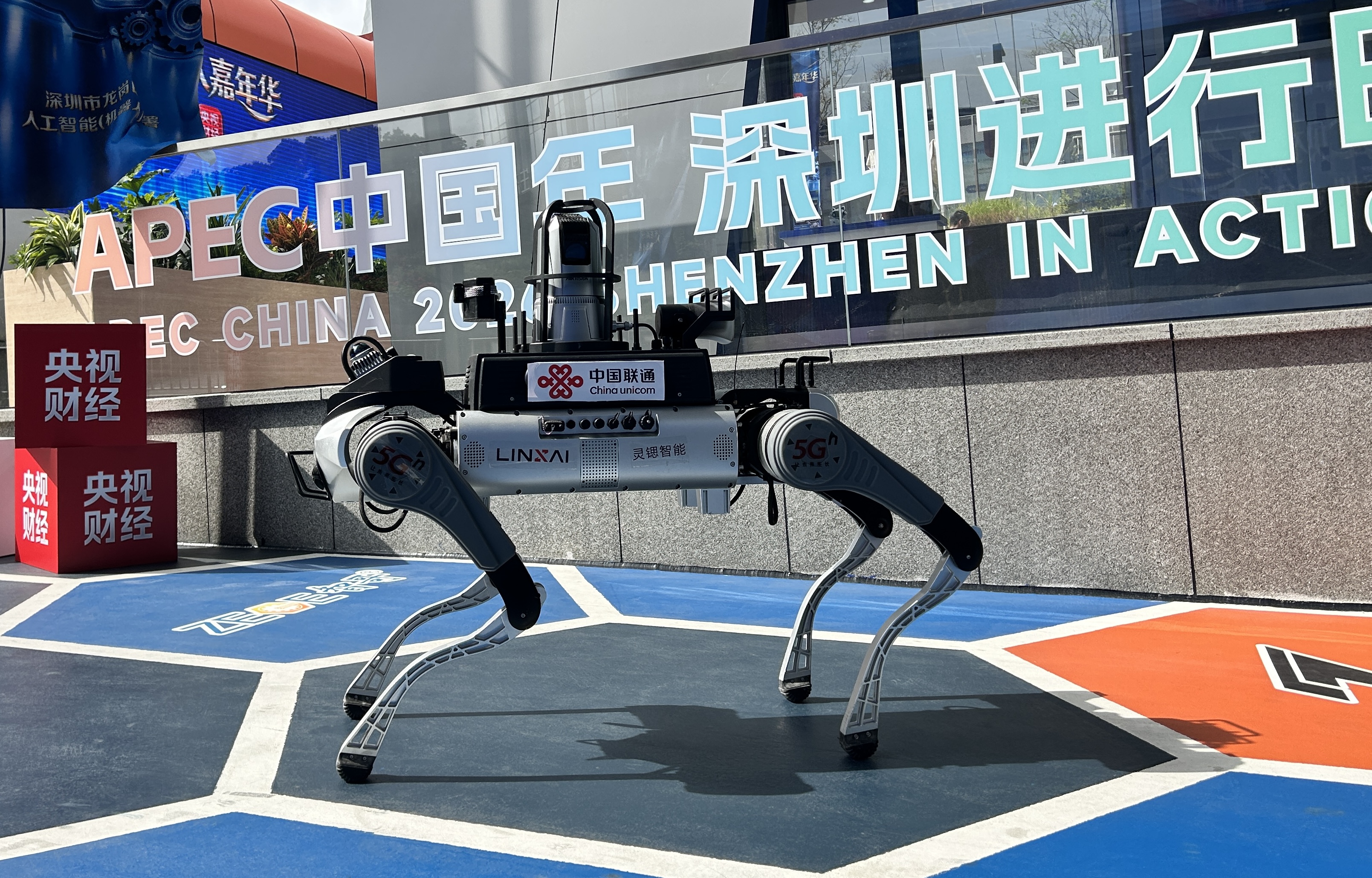
Backed by a deepening Greater Bay Area industrial base, LINXAI is moving heavy-payload quadrupeds from demonstration to real-world deployment.
By LINXAI · November 2026
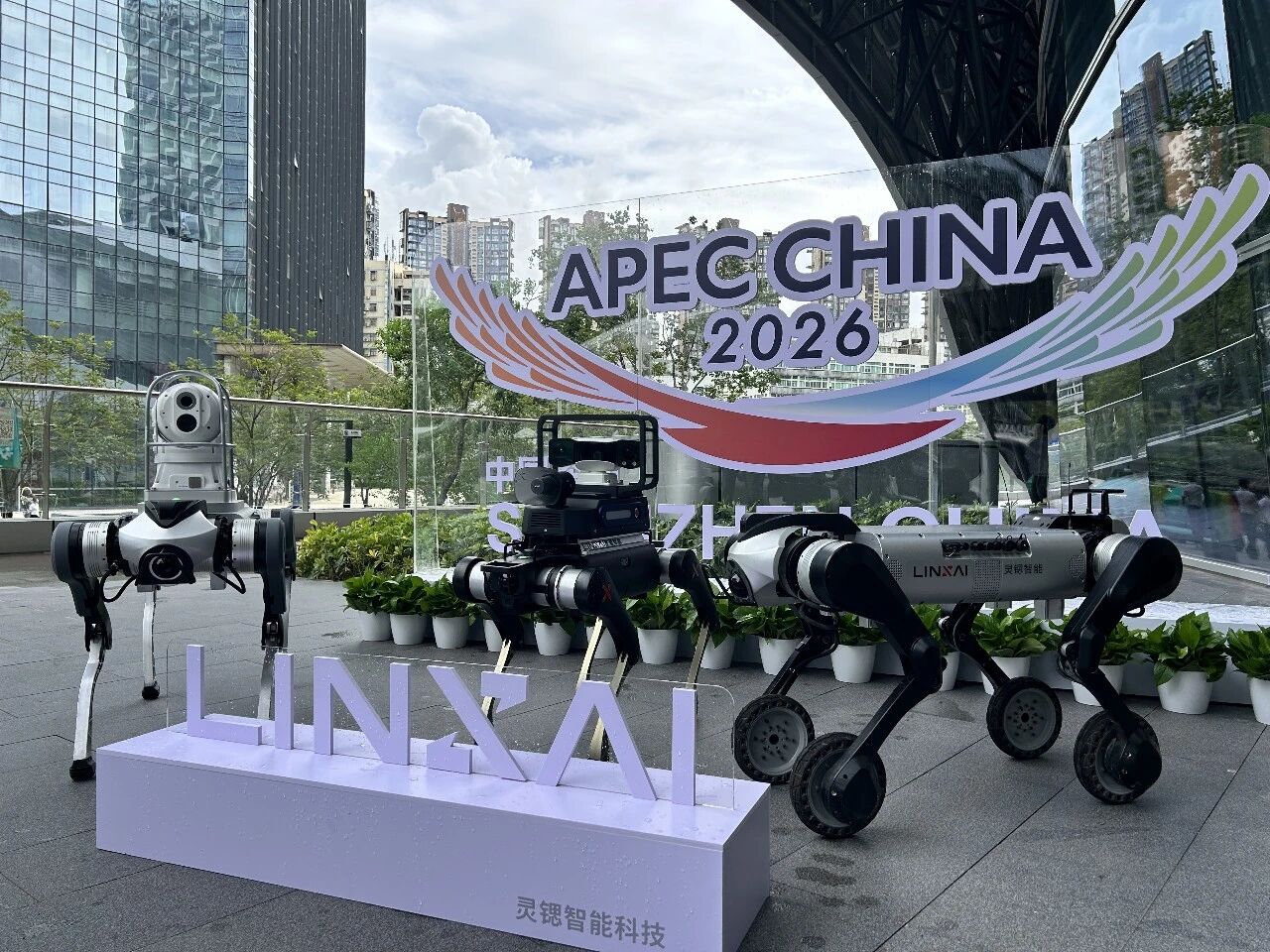
The next phase of robotics will be shaped not only by what robots can demonstrate, but by where they can work. For LINXAI, a Shenzhen-based quadruped robotics company, the opportunity is emerging at the intersection of two forces: the Guangdong–Hong Kong–Macao Greater Bay Area’s accelerating industrial integration, and a fast-growing market for robots that can carry real loads in complex environments.LINXAI’s recent appearances during the APEC China-Year showcase activities — together with its results at the inaugural CMG World Robot Mount Tai Challenge and its forestry deployment with partners — illustrate how heavy-payload quadruped robots are moving beyond the show floor.
A region built on connectivity — and industrial upgrading
The Guangdong–Hong Kong–Macao Greater Bay Area continues to advance infrastructure connectivity and coordinated industrial development across the region. According to People’s Daily, a visit to Zhongshan, Guangdong on 16 November 2026 focused on integrated development between the eastern and western banks of the Pearl River Estuary.
The delegation visited the West Artificial Island of the Shenzhen–Zhongshan Link to review the crossing’s construction and operation, noting that transport integration should be prioritised and that the link’s connecting role should support the region’s high-quality development. At the exhibition hall of the Greater Bay Area Future Science and Technology City, the delegation reviewed Zhongshan’s work in biomedicine, electronic information and high-end equipment — covering both emerging industries and the upgrading of traditional manufacturing — with particular attention to product R&D and the commercialisation of new technologies.
The two stops describe one strategy. Physical connectivity moves goods, people and capital across the estuary; industrial upgrading determines what those corridors carry. For robotics companies, that combination is the difference between a demonstration and a market.
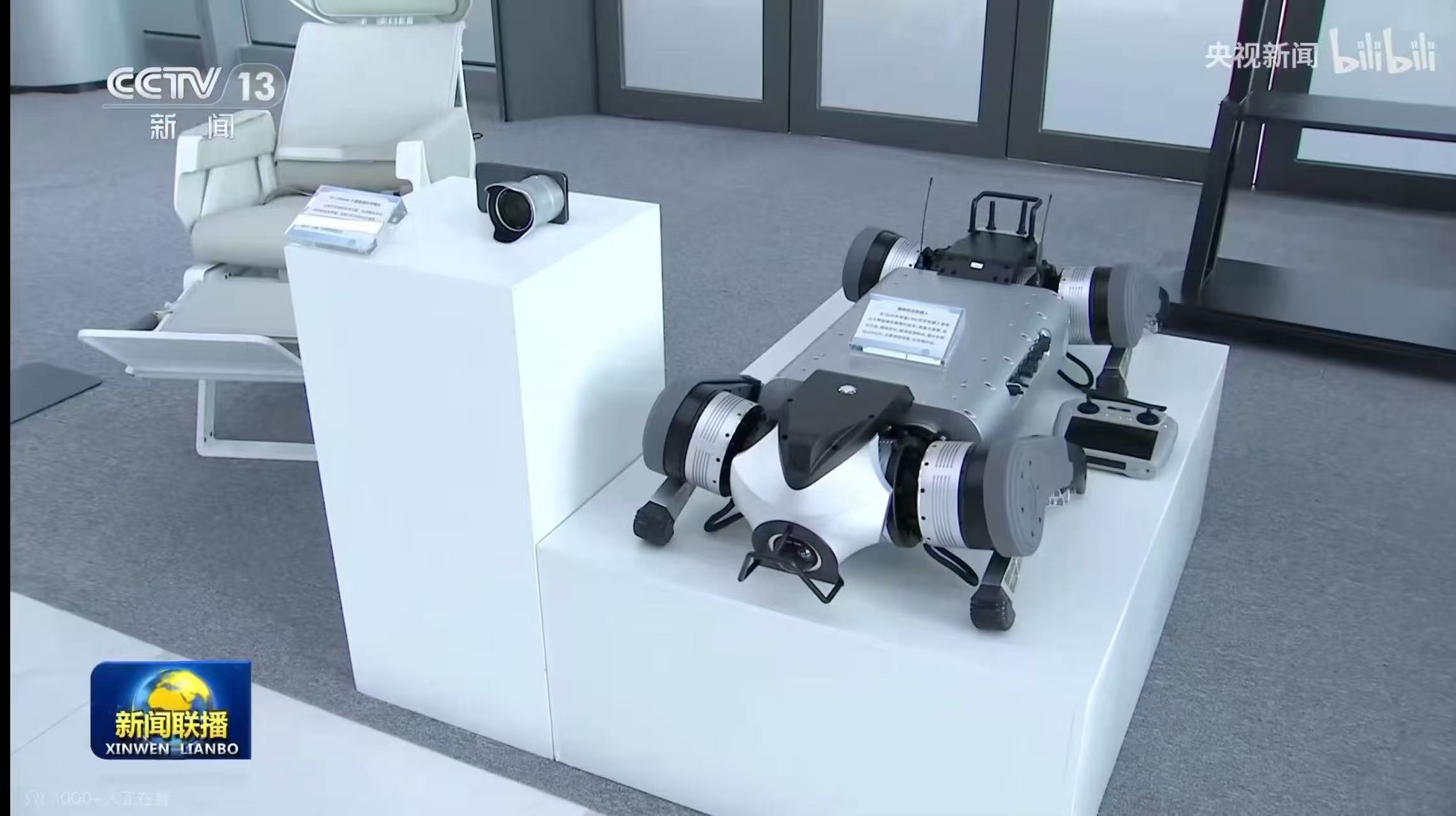
At the Greater Bay Area Future Science and Technology City, established manufacturing and intelligent technology were presented side by side — a manufacturing base built up over four decades, and the automation layer now being added to it.
A heavy-payload platform built for work, not the show floor
LINXAI sits on the second side of that equation. Its D50 quadruped robot combines fully autonomous navigation, multi-sensor fusion perception and the company’s in-house SVIP motion-control algorithm with a 50 kg continuous payload, IP67 ingress protection and stable operation across a wide temperature range.
These specifications are aimed at sustained work in complex terrain and harsh environments rather than at show-floor demonstrations. LINXAI’s product line is built around heavy payload capability: stable walking and agile turning, posture adjustment and traversal of complex terrain, demonstrated live to visitors.
What audiences see is not only a robot but a load-bearing platform — the basis for applications in industrial inspection, emergency response and public safety, where the constraint is rarely mobility alone, but how much equipment the platform can carry while remaining mobile.
Proven on Mount Tai
Those specifications have now been tested in competition. At the inaugural CMG World Robot Mount Tai Challenge, LINXAI’s D50 completed a course of roughly 3.9 km and more than 3,100 stone steps to take first and third place in the legged payload event, together with third place in the legged sprint — one gold and two bronzes, with the robot carrying its load unaided across the full ascent.
(2).jpg)
D50 on the Mount Tai course, which covered roughly 3.9 km and more than 3,100 stone steps. LINXAI took first and third place in the legged payload event.
APEC China-Year showcases: Longgang and Huaqiangbei
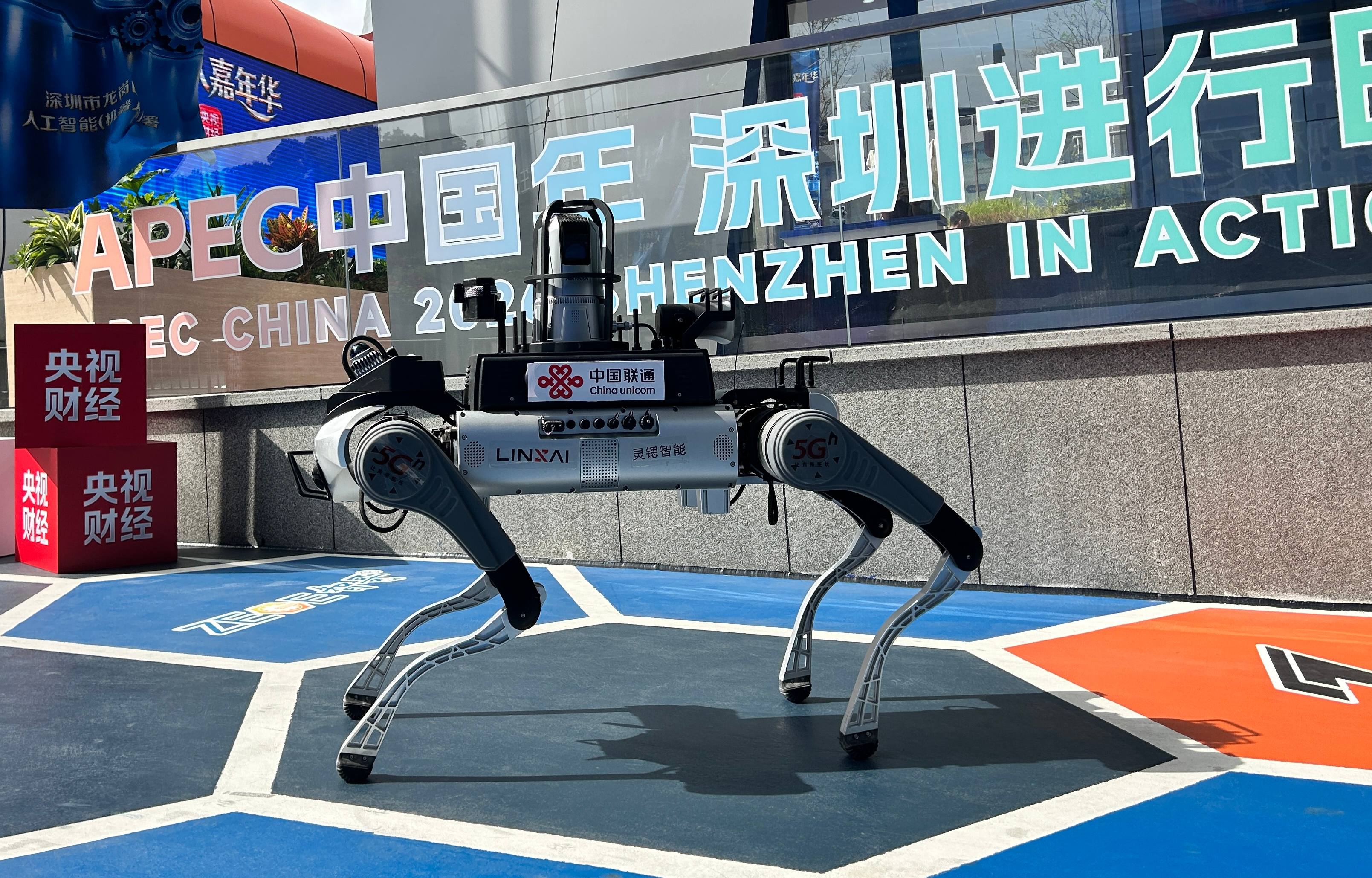
Greater Bay Area innovation is also being presented on more open platforms. During the APEC China-Year showcase activities, LINXAI’s quadruped robots appeared at the AI Robot Street in Longgang, Shenzhen, alongside a wide range of other robotic systems, presenting the applied results of artificial intelligence and robotics.
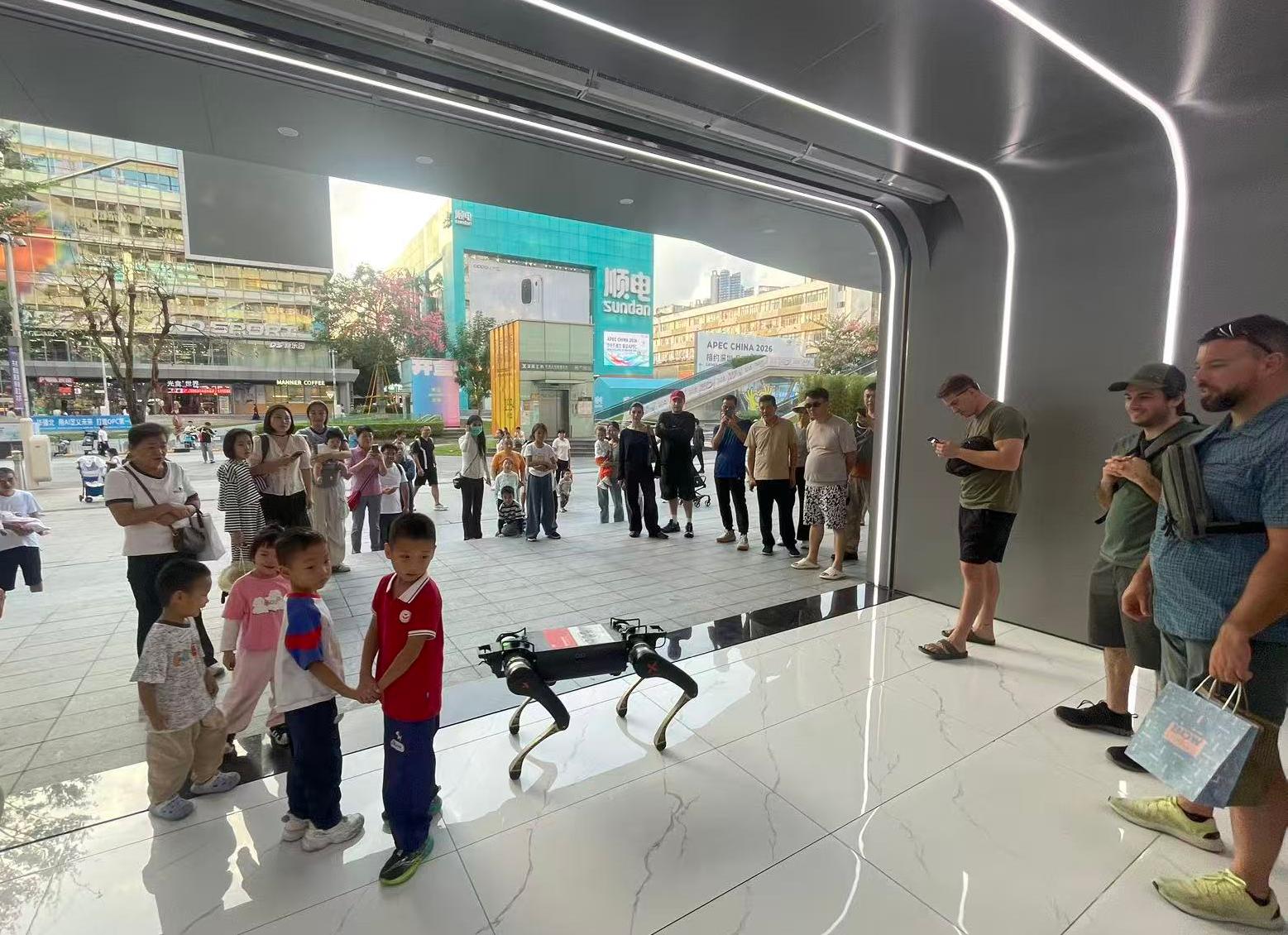
APEC Longgang showcase
LINXAI’s positioning differs from that of the lightweight quadrupeds that dominate consumer and research markets. The company’s product line is built around heavy payload capability, with live demonstrations of stable walking, agile turning, posture adjustment and traversal of complex terrain.
At the Huaqiangbei electronics district, a second showcase drew crowds of domestic and international visitors, who stopped for gait demonstrations and obstacle crossing. Huaqiangbei is one of the world’s largest electronics marketplaces and a working symbol of Shenzhen’s hardware supply chain. A Shenzhen-designed quadruped walking through it is, in effect, a supply-chain argument made visible.
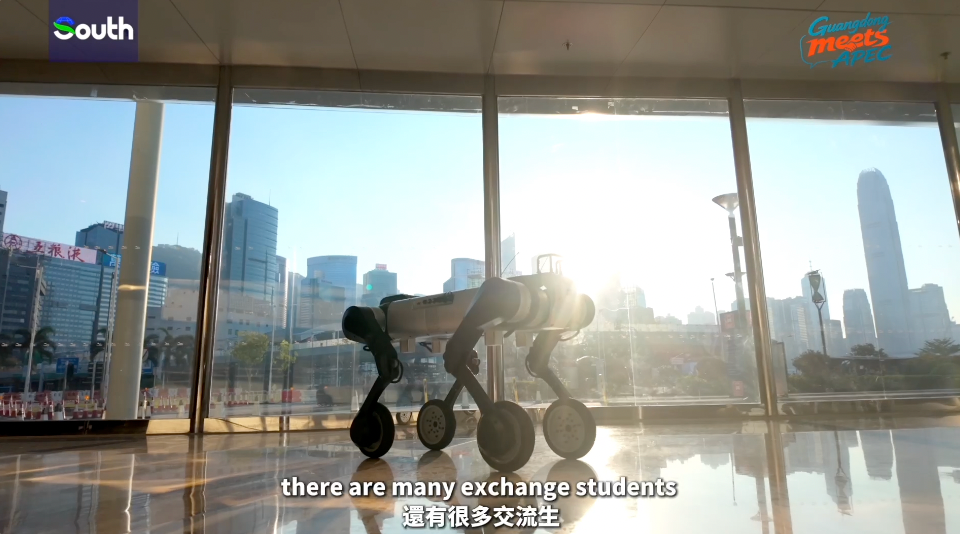
From forest resilience to industrial deployment
The same platform has already been applied outside the factory floor. At the 2026 APEC Forestry Ministerial Meeting held in Shenzhen in July, LINXAI’s D50 and its mid-size D30 — with 50 kg and 30 kg continuous payloads respectively — performed in the event’s Smart Forestry Theatre, demonstrating gait switching, in-place posture adjustment, synchronised formation movement and stair climbing in front of forestry delegates from across the Asia-Pacific.

D50 and D30 units in the Smart Forestry Theatre at the 2026 APEC Forestry Ministerial Meeting in Shenzhen.
The demonstration reflected a solution developed with partners for forest management, built on three capabilities: autonomous area-wide patrol that replaces manual rounds with 24-hour monitoring of fire risk, pests and vegetation change; access to terrain that people cannot safely reach, including steep slopes, scree, leaf-covered mud and dense undergrowth; and multi-sensor payloads that collect environmental and imaging data and transmit it back in real time, forming a digital monitoring network over forest areas.
For the forestry sector, the economics are straightforward: patrol coverage expands, while the number of people exposed to hazardous field conditions falls.
A market that is scaling
The commercial context has shifted quickly. According to Shenzhen Customs, Shenzhen’s exports of separately listed robotics products reached RMB 8.58 billion in the first seven months of 2026, up 10.5 times year on year — a rate of growth that reflects both overseas demand and the maturity of the local supply chain that serves it.
Capital has followed. In August 2026, LINXAI completed a RMB 70 million strategic financing round led by the Zhongshan Gaoxin Zhiguang Venture Capital Fund, with proceeds directed to product iteration, expansion of intelligent production lines and development of domestic and overseas sales channels.
Looking ahead
In the future, LINXAI will continue to dig deep into the core technologies of heavy-load quadruped robots, make continuous breakthroughs in greater load capacity and stronger all-terrain trafficability, and expand the boundaries of heavy-load applications such as industrial inspection, emergency rescue and public safety. The goal is to enable robots to go to more complex, arduous and dangerous places and undertake important tasks that ordinary quadruped robots are difficult to fulfil.
With down-to-earth innovation, LINXAI will contribute its strength to the high-quality development of the Guangdong–Hong Kong–Macao Greater Bay Area and to the realisation of high-level scientific and technological self-reliance and self-improvement.